Why Choose a Dry Type Transformer Substation?
Why Choose a Dry Type Transformer Substation?
Electricity demand is changing faster than many facility plans. The International Energy Agency’s Electricity 2024 report projects global electricity demand will grow by about 3.4% annually through 2026. This growth increases pressure on substations serving factories, hospitals, data centers, and commercial buildings. In these locations, equipment must deliver stable power while reducing fire, leakage, and maintenance concerns.
A Dry Type Transformer Substation uses air or solid insulation instead of liquid oil. This design can remove oil containment requirements and reduce the consequences of a transformer leak. Cast-resin units also perform well in dusty indoor rooms and buildings with limited outdoor space. However, “safer” does not mean risk-free. Heat, noise, dust, and installation errors still matter. Engineers should verify ventilation, clearances, enclosure ratings, and short-circuit withstand capacity.
IEC 60076-11 defines requirements for dry-type power transformers, supporting consistent design and testing practices. The U.S. Department of Energy’s transformer efficiency standards also show why losses deserve careful attention during procurement. A small efficiency difference can become a large operating cost over decades of continuous service. That point is easy to underestimate.
The better choice depends on the site.
For example, a hospital may value indoor placement and reduced fire exposure. A coastal plant may prioritize corrosion resistance and enclosure protection. A high-rise project may focus on weight, access, and noise. Dry-type technology offers strong advantages, but only when the complete substation design matches the operating environment.
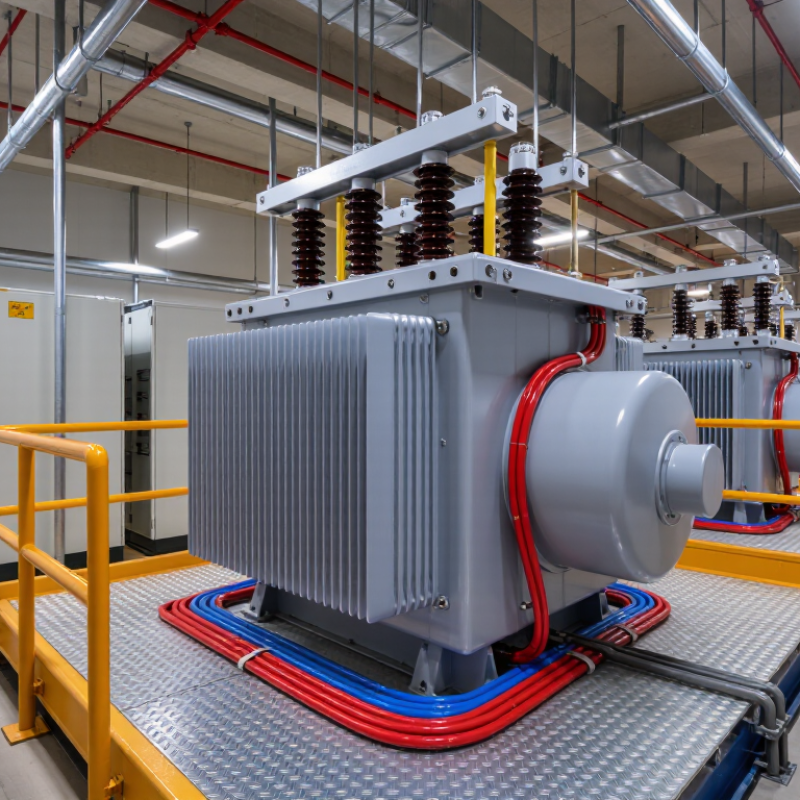
What a Dry Type Transformer Substation Is
Why Choose a Dry Type Transformer Substation?
What a Dry Type Transformer Substation Is
A dry type transformer substation combines a dry type transformer with switchgear, protection devices, and distribution equipment. It changes medium voltage into usable low voltage without liquid insulation. Instead, solid insulation and surrounding air manage electrical separation and heat.
These substations are often installed inside commercial buildings, factories, hospitals, and transport facilities. They suit locations where oil leakage, fire risk, or limited ventilation requires careful control. A typical unit may include an enclosed transformer, circuit breakers, busbars, sensors, and cable connections. Its compact layout can simplify indoor installation.
Safety still depends on design.
From field experience, dry type equipment usually needs less spill management than oil-filled equipment. However, it is not maintenance-free. Dust can settle on cooling openings and reduce heat dissipation. High humidity may also weaken insulation performance over time. Engineers should check loading, ambient temperature, noise limits, and fault levels before selecting capacity. Local electrical codes and verified technical data must guide the final design.
Tips: Keep ventilation paths clear and inspect terminals for discoloration, looseness, or unusual heating. Record temperature readings during heavy loads. Leave access space around the enclosure for safe testing and cleaning. A qualified technician should perform isolation, testing, and protection checks. When the substation operates near sensitive offices, schools, or laboratories, acoustic performance deserves attention, not just electrical capacity.
How Dry Type Transformer Substations Operate
A dry type transformer substation transfers electrical energy without liquid insulation. During operation, alternating current enters the primary winding and creates a magnetic field. Magnetic flux crosses the core and induces voltage in the secondary winding. The output voltage then feeds switchgear, lighting, motors, or sensitive equipment. Cast-resin and air-insulated designs remove the need for an oil-filled tank. They also reduce leakage concerns inside buildings. Ventilation removes heat through ducts, fans, or natural airflow. Quiet operation is possible, but poor airflow can still raise winding temperature.
When electrical demand increases, copper and core losses create more heat. Sensors monitor temperature, while protection devices respond to overloads and faults. IEC 60076-11 provides requirements for dry type transformers. The U.S. Department of Energy’s 2016 Distribution Transformers Technical Support Document estimated that improved efficiency standards could save 3.6 quadrillion Btu over 30 years. This matters because small losses continue every hour. Still, efficiency does not guarantee reliable operation. Dust, blocked vents, and harmonics can shorten insulation life. That detail is often underestimated.
Tips: Keep ventilation openings clear and record temperature readings during peak loads. Inspect terminals for discoloration or loose connections. Do not assume “maintenance-free” means “inspection-free.” For hospitals and high-rise buildings, confirm fire ratings, sound limits, space clearances, and emergency coordination before installation. A careful site review usually prevents expensive surprises.
Where Dry Type Transformer Substations Are Used
Dry type transformer substations are widely used where fire safety, indoor installation, and environmental control matter. They use solid insulation instead of mineral oil, reducing leakage concerns inside occupied buildings. Hospitals, schools, shopping centers, airports, and high-rise offices often place them near electrical rooms. Space matters. Their compact enclosure can support installation close to major loads.
Industrial facilities use dry type substations in factories, workshops, and clean production areas. They are also common in metro stations, tunnels, marine terminals, and renewable energy sites. The IEA’s Electricity 2024 report projects data center electricity consumption will more than double by 2026, exceeding 1,000 TWh worldwide. This growth increases demand for indoor substations near servers and cooling systems. Dry type units can serve these loads when engineers control harmonics, heat, noise, and ventilation.
The U.S. Department of Energy’s 2024 distribution transformer rule estimates about 3.6 quadrillion Btu in energy savings over thirty years from stronger efficiency requirements. That figure concerns distribution transformers broadly, not dry type units alone. Still, it shows why lifecycle efficiency deserves attention. Field commissioning experience also reveals a less convenient truth: dry type does not mean maintenance-free. Dust, blocked airflow, high humidity, and repeated overloads can shorten insulation life. They may be the right choice for a hospital basement, but a remote outdoor yard may favor another design. The choice is not automatic.
Factors for Selecting the Right Substation Design
Why Choose a Dry Type Transformer Substation?
Factors for Selecting the Right Substation Design
Selecting a dry type transformer substation begins with the site, not the equipment catalog. Indoor buildings, hospitals, schools, and commercial facilities often need reduced fire risk. Dry insulation removes the need for liquid containment and leak management. That matters in crowded electrical rooms. Still, dry type does not mean maintenance-free. Dust, moisture, and blocked ventilation can raise winding temperatures quickly.
Load behavior deserves careful study. Engineers should check peak demand, motor starting currents, harmonics, and future expansion. A transformer sized only for today may become a costly restriction. Oversizing also has disadvantages, including higher purchase costs and weaker efficiency at light loads. The choice is rarely perfect. Real operating data is better than optimistic forecasts.
The enclosure must match the environment. A clean indoor room may require a different protection level than a humid or dusty workshop. Confirm cooling clearances, noise limits, access routes, and lifting capacity before approval. Check applicable electrical codes and test certificates from qualified laboratories. Site temperature can reduce available capacity, especially where natural ventilation is poor. It is tempting to focus on initial price. However, energy losses, inspections, cleaning, and downtime shape the life-cycle cost. A practical design leaves space for inspection and future cable changes, even when the original layout seems sufficient.
Why Choose a Dry-Type Transformer Substation?
Dry-type transformers are often selected for indoor substations, public buildings, tunnels, industrial facilities, and locations where liquid containment and fire-safety requirements are important. The chart shows the standardized insulation thermal classes used for dry-type transformers.
A lower thermal class may be preferred when reduced operating temperature and long-term thermal stress are priorities, while higher classes can support compact designs when the complete thermal, load, enclosure, and ventilation design is suitable. The final selection should also consider indoor installation, fire protection, ambient temperature, altitude, dust and moisture, maintenance access, noise, short-circuit withstand, and total lifecycle cost.
Thermal-class values are standardized reference values from IEC 60076-11; the transformer’s actual temperature rise and rating must be confirmed by the manufacturer for the specified operating conditions.
