
7 Tips for Choosing a Three Phase Diesel Generator?

Choosing a Three Phase Diesel Generator is not simply a matter of comparing engine size or purchase price. It is a decision about continuity, safety, fuel use, and recovery when the utility supply fails. In a hospital, factory, or data center, a few seconds can interrupt sensitive equipment, production lines, or cooling systems. The International Energy Agency’s Electricity 2024 report projects that global data-center electricity consumption could more than double by 2026. That pressure makes dependable backup power increasingly important.

Energy expert Dr. Michael E. Webber has said, “Energy is the only thing that makes everything else possible.” His observation fits generator selection closely. A suitable Three Phase Diesel Generator must match actual load demand, starting currents, voltage requirements, operating hours, and site conditions. Oversizing may waste fuel and reduce efficiency. Undersizing can cause overloads, unstable frequency, and premature wear. The right choice is rarely obvious.

Uptime Institute’s Global Data Center Survey consistently identifies power problems among the most serious causes of service disruption. That finding should encourage practical testing, not confident assumptions. Check the alternator, controller, automatic transfer switch, emissions system, fuel storage, and maintenance access. Listen for uneven running. Inspect the installation space. Small details matter. Yet specifications alone cannot predict every failure. A carefully measured load profile, professional commissioning, and realistic maintenance plan provide stronger evidence than a brochure. These seven tips will examine those decisions clearly, while acknowledging one uncomfortable truth: even a well-selected generator can fail without disciplined testing and human oversight.
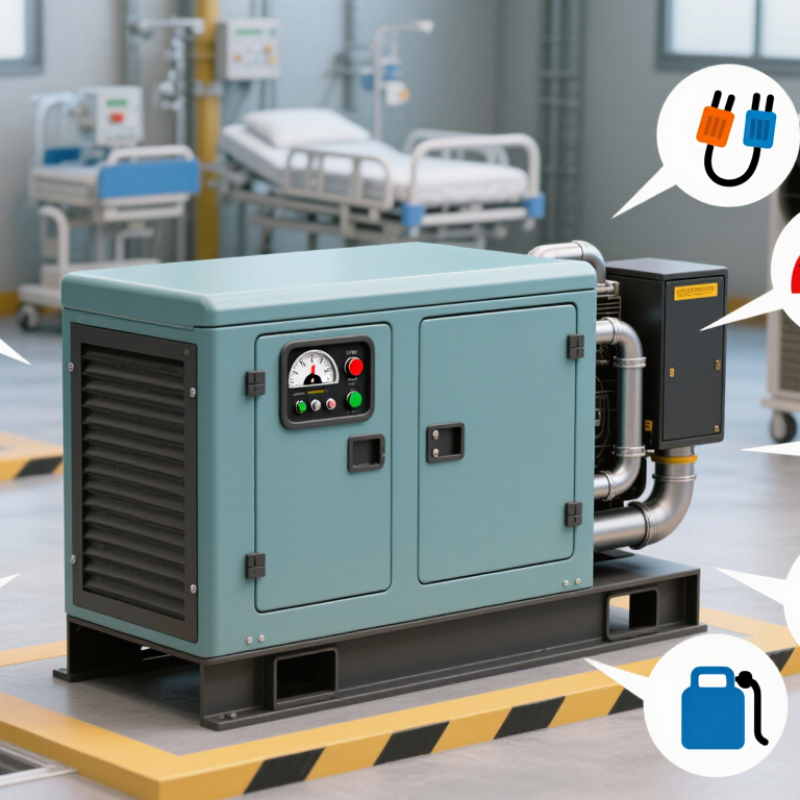
7 Tips for Choosing a Three Phase Diesel Generator?

Define the Power Requirements and Operating Conditions

7 Tips for Choosing a Three Phase Diesel Generator

Define the Power Requirements and Operating Conditions

Start with measured demand, not an equipment label. Record running kW, power factor, motor-starting current, and future expansion. A generator rated at 500 kVA delivers about 400 kW at a 0.8 power factor. That difference matters.

List every load by sequence. Pumps, compressors, elevators, and cooling systems may start together. Their short surges can trip an undersized generator. The International Energy Agency’s Electricity 2024 report projects data-center electricity use to exceed 1,000 TWh by 2026. Growing digital loads make accurate capacity planning less optional.

Operating conditions can quietly reduce output. High altitude, hot air, blocked ventilation, and long exhaust piping all affect performance. Check the generator’s derating tables for the actual installation site. Also identify whether the unit will provide standby, prime, or continuous power. ISO 8528-1 distinguishes these ratings and their allowable operating limits.

Do not ignore load imbalance.

Measure each phase separately.

A three-phase system should maintain balanced loading whenever possible. Unbalanced current increases heating and may shorten alternator life. Field assessments often reveal assumptions that drawings miss. I have seen “spare” capacity disappear after adding battery chargers, heaters, and control panels. Recheck the calculation with real operating data, then allow practical headroom without oversizing the engine unnecessarily.

Calculate Load Capacity, Starting Power, and Future Expansion

7 Tips for Choosing a Three Phase Diesel Generator

Calculate the real running load before comparing generator sizes. Add lighting, pumps, refrigeration, controls, and heating equipment separately. A 500 kW connected load does not always require a 500 kW generator. Measure actual demand during peak operation. The U.S. Energy Information Administration reports that commercial buildings often experience significant variation between connected and peak loads. That difference can prevent costly oversizing.

Starting power deserves closer attention. Motors may draw five to seven times their normal running current, according to U.S. Department of Energy motor-system guidance. A pump starting beside an air compressor can briefly overload an undersized set. Record each motor’s starting method, locked-rotor current, and sequence. ISO 8528-5 evaluates generator performance during sudden load changes, so transient response matters beyond the nameplate rating. Test the worst case.

Future expansion is easy to underestimate. Reserve capacity for planned pumps, chargers, servers, or production equipment. A practical allowance of 20% to 30% can provide flexibility, but site conditions should decide the figure. I have seen projects reserve capacity for new equipment, then forget ventilation fans and control panels. That was not a minor mistake. The 2024 Uptime Institute Annual Outage Analysis reported that 53% of respondents experienced outages causing significant damage. Load-bank testing, documented assumptions, and periodic review improve reliability. A spreadsheet helps. It cannot replace a site walk.

Compare Engine, Alternator, Control System, and Safety Features

7 Tips for Choosing a Three Phase Diesel Generator

Start with the engine. Check its continuous power rating, fuel consumption, cooling method, and response to sudden loads. A unit running near maximum capacity may overheat, especially in dusty rooms or high temperatures. Choose enough reserve for pumps, compressors, and motor starting currents. Read the data plate.

Then inspect the alternator. Confirm its continuous kVA rating, insulation class, voltage stability, and frequency control. An automatic voltage regulator helps protect sensitive equipment from damaging fluctuations. Select an alternator suited to unbalanced loads if your facility uses different single-phase circuits.

The control system deserves practical testing, not only a brochure review. Look for clear alarms, emergency shutdown functions, remote monitoring, and records for oil pressure, coolant temperature, and battery voltage. Test whether operators can understand the display during a noisy night shift. Safety features should include overload protection, earth-fault protection, guarded hot surfaces, secure fuel connections, and a lockable emergency stop.

Leave space around the enclosure for ventilation and maintenance access. A cramped installation can turn a simple filter change into unsafe work. Check service intervals, spare-part availability, and technician training before purchase.

Paper specifications can look perfect. Field conditions are less forgiving. A proper load-bank test may reveal unstable voltage, weak batteries, or poor cooling before an actual outage. Allow for reality.

Evaluate Fuel Efficiency, Emissions, Noise, and Runtime

7 Tips for Choosing a Three Phase Diesel Generator

Evaluate Fuel Efficiency, Emissions, Noise, and Runtime

Start with the generator’s fuel curve, not its advertised maximum output. A three phase unit may consume far more diesel when lightly loaded. Compare liters per hour at 25%, 50%, 75%, and 100% load. Measure your actual demand with a power analyzer for several working days. This small step often reveals an oversized generator. It happened on one site I inspected.

Check the engine’s emissions certification and maintenance requirements before purchase. Cleaner exhaust usually depends on correct servicing, suitable fuel, and proper operating temperature. Ask for test documents, service intervals, and the expected replacement schedule for filters. Requirements differ between regions, so verify them with a qualified local technician. Do not rely on a sales sheet alone. It can omit inconvenient details.

Noise deserves a field check. Stand several meters away while the generator runs under load, because idle testing is misleading. Look for measured sound levels, enclosure design, vibration control, and placement options. For runtime, calculate tank capacity against real fuel consumption, then allow a safety margin for cold starts and changing loads. A transfer switch, remote monitoring system, and clear service access can also improve reliability. Still, every estimate has limits; dust, heat, neglected filters, and unstable loads may shorten runtime. Inspect those conditions honestly before selecting the final capacity.

7 Tips for Choosing a Three Phase Diesel Generator? - Evaluate Fuel Efficiency, Emissions, Noise, and Runtime

No. Selection Tip What to Evaluate Typical Reference Data Why It Matters How to Verify
1 Match the Three-Phase Rating Confirm the generator’s continuous and standby ratings in kW and kVA. Check the rated power factor and whether the load is balanced across all three phases. kW = kVA × power factor
A common rated power factor is 0.8. Avoid continuous operation above the manufacturer’s prime-power rating.
Correct sizing prevents overheating, voltage instability, nuisance shutdowns, and poor fuel economy. Add running load, motor-starting demand, and future capacity. Review the load schedule and phase measurements.
2 Compare Fuel Efficiency Compare fuel consumption at 25%, 50%, 75%, and 100% load rather than relying on a single maximum-load figure. Typical diesel consumption is approximately 0.24–0.30 L/kWh at 75–100% load and may rise to about 0.35–0.50 L/kWh at 25% load. Fuel cost is often the largest operating expense over the generator’s service life. Request a fuel-consumption curve or test sheet using the same rating standard and fuel conditions.
3 Check Emissions Compliance Verify the applicable emissions certification, including limits for nitrogen oxides, particulate matter, hydrocarbons, and carbon monoxide. Requirements vary by location and engine power. Current regulations may require certification such as EPA Tier 4 Final or EU Stage V for applicable non-road engines. Non-compliant equipment can face operating restrictions, additional permitting, or costly retrofit requirements. Check the official certificate, engine family information, installation rules, and local air-quality regulations.
4 Evaluate Noise Level Compare sound pressure levels for open-frame and acoustically enclosed configurations, including the measurement distance and operating load. Enclosed sets commonly measure about 70–85 dB(A) at 7 m; open-frame units may be approximately 85–100 dB(A) at 7 m, depending on size and enclosure design. Lower noise is important near homes, offices, hospitals, schools, and temporary work areas. Request a certified sound test using a recognized measurement method and confirm local noise limits.
5 Calculate Required Runtime Compare usable tank capacity with expected fuel consumption at the actual operating load. Estimated runtime (hours) = usable fuel volume (L) ÷ fuel consumption (L/h).
Example: 500 L ÷ 30 L/h ≈ 16.7 hours.
Adequate runtime reduces refueling interruptions and improves resilience during extended outages. Use the supplier’s hourly fuel-consumption data and subtract reserve fuel that should not be used.
6 Review Load Acceptance Check voltage and frequency recovery when large motors, pumps, compressors, or transformers start. A generator should be assessed for transient performance, motor-starting kVA, voltage dip, and frequency recovery—not only steady-state kW. Poor load acceptance can cause equipment trips, dimming lights, process interruptions, or failed motor starts. Request transient test results and model the largest starting load and the planned load-sequencing strategy.
7 Assess Maintenance and Controls Review service intervals, oil and coolant capacity, automatic transfer-switch compatibility, alarms, remote monitoring, and spare-parts access. Preventive maintenance commonly includes regular inspections, oil and filter replacement, coolant checks, battery testing, and periodic load-bank testing; intervals depend on operating hours and the maintenance schedule. Easy maintenance and clear diagnostics reduce downtime and total ownership cost. Obtain the service manual, maintenance schedule, warranty terms, control-panel specifications, and emergency support details.

Note: Fuel-consumption and noise figures are typical industry ranges for preliminary comparison only. Actual performance depends on generator size, load profile, enclosure, ambient conditions, installation, fuel quality, and applicable test standards.

Check Installation Needs, Maintenance Support, Warranty, and Cost

Choosing a three-phase diesel generator starts with the site, not the advertised kilowatt figure.

Measure starting currents, continuous loads, altitude, ambient heat, ventilation, exhaust routing, fuel storage, and transfer-switch space. ISO 8528-1 defines generator performance classifications, but local electrical and emissions rules still control acceptance.

An overloaded unit may run quietly for months, then fail during a motor start. That unpleasant lesson is easy to miss.

Maintenance support deserves a line-by-line test.

Ask for response times, technician coverage, spare-filter availability, load-bank testing, and documented service intervals. NFPA 110 emphasizes periodic inspection and testing for emergency power systems. Match that schedule with local authority requirements.

The Uptime Institute’s 2024 Global Data Center Survey still lists power issues among leading outage causes. Do not accept vague promises. Read warranty exclusions for fuel contamination, standby hours, batteries, labor, and remote sites.

Cost is more than purchase price.

Compare fuel consumption at 25%, 50%, and 75% load, scheduled service, transfer equipment, commissioning, and disposal. The U.S. Department of Energy’s 2024 data-center report projects U.S. data-center electricity use could reach 6.7–12% by 2028.

That forecast makes efficiency and maintainability practical financial concerns, not decorative specifications. Get three lifecycle quotes.

A cheaper set can become expensive when parts arrive slowly or testing is skipped. Some assumptions will be wrong; record them, challenge them, and revise the comparison before signing.

Go to Top