
China Top 10 Industrial Cable Reel Manufacturers

Choosing an Industrial Cable Reel manufacturer involves more than comparing prices or browsing polished product photos. Reels may serve workshops, construction sites, ports, factories, or mobile equipment, and each setting places different demands on cable capacity, enclosure strength, braking, and handling. A reel that looks suitable on a screen may not fit the cable’s diameter or the space available beside a machine. Small details matter.

This guide introduces ten manufacturers in China and outlines practical points buyers can investigate before requesting a quotation. It considers product range, customization, material choices, stated load ratings, quality-control information, and communication during the sample and ordering process. These factors help readers ask more specific questions, such as whether a reel can accommodate a stated cable length or withstand frequent movement in a dusty workshop. Ask for drawings and test records where relevant. Verify the details.

A manufacturer’s website can offer useful clues, but it cannot prove how a product will perform in your exact application. No catalog tells the whole story. Confirm specifications directly, compare like-for-like configurations, and clarify lead times, packaging, replacement parts, and after-sales support. Rankings and suitability can also vary by project; the most recognizable supplier may not be the right fit for every buyer. The companies featured here provide a starting point for research, not a substitute for technical evaluation. Some comparisons may remain imperfect, because public information is not equally detailed for every manufacturer. That is worth remembering.
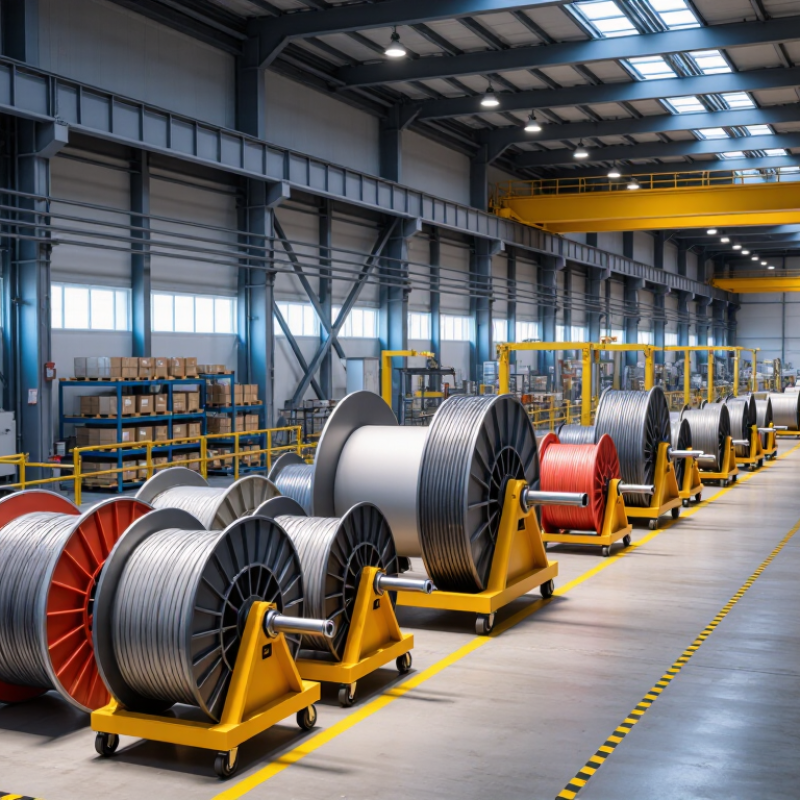
China Top 10 Industrial Cable Reel Manufacturers

Industrial Cable Reels: Definition, Types, and Applications

An industrial cable reel stores and pays out flexible cable while helping control tension, twist, and wear. Its drum turns as equipment moves or an operator pulls cable. Many reels include a frame, rotating hub, cable guide, and electrical connection. The design keeps cable off wet floors and away from wheels or sharp edges. Small details matter.

Common types include manual, spring-driven, and motor-driven reels. Manual reels suit shorter runs and occasional use. Spring reels retract cable automatically, which can reduce slack around workstations. Motor-driven models handle longer cable runs or frequent movement, but need suitable controls and power. Some reels use slip rings to maintain electrical contact while the drum rotates; others are designed for specific cable or signal needs.

Reels appear on cranes, material-handling equipment, service vehicles, and production lines. A reel for a slow-moving indoor machine may not suit a fast outdoor application. Check cable length, conductor size, voltage, load, travel speed, and duty cycle before choosing. Also consider dust, moisture, temperature, and mounting space. I have seen tidy installations become troublesome when the cable is too stiff or the reel is poorly aligned. Specifications help, but the actual movement path deserves a close look.

How China’s Industrial Cable Reel Industry Is Organized

China’s industrial cable reel industry is organized around specialized manufacturers and a broad component supply chain. Some factories focus on reel frames, drums, and cable guides. Others assemble spring-driven, motorized, or manual systems. Steel, bearings, slip rings, motors, and electrical controls often come from separate suppliers. This structure allows manufacturers to offer varied configurations without making every component in-house. It is not uniform. Production capabilities and quality controls differ between factories.

Many producers serve equipment makers, workshops, ports, and material-handling operations. Their work may include drawing review, sample production, assembly, and inspection. Customization can involve cable length, reel capacity, mounting style, or operating conditions. A practical evaluation should look beyond catalog specifications. Ask how the supplier checks winding tension, electrical continuity, and mechanical operation. Requesting relevant test records can clarify what “tested” means. That detail is sometimes overlooked.

Tips: Share the cable type, length, and duty cycle before requesting a quotation. Confirm installation space and operating environment. Compare inspection details, not just price. A clear drawing helps, though early specifications may still need revision.

Criteria for Selecting Industrial Cable Reel Manufacturers

Selecting an industrial cable reel manufacturer begins with the operating conditions, not the catalog. Define cable type, length, weight, voltage, and required retraction speed. A reel handling a light signal cable may not suit a heavy power cable. Check drum dimensions, mounting space, duty cycle, and exposure to dust, moisture, or temperature changes. Ask how the design manages cable tension, braking, and electrical connections. Clear drawings and test records matter.

Tips: Share a real installation layout and cable data before requesting a quote. Ask for evidence of testing under comparable loads. Confirm spare-part availability and service response times in writing.

Review the manufacturer’s engineering experience with similar applications, but look beyond project lists. Ask who checks the design, what tolerances apply, and how maintenance access is planned. Compare quotations by materials, controls, commissioning support, and expected service life, not price alone. If possible, assess a sample or inspect a finished unit. A polished specification sheet can still miss an awkward cable path or tight mounting clearance. I have seen small details change the installation plan, so leave room for a practical design review.

China Top 10 Industrial Cable Reel Manufacturers - Criteria for Selecting Industrial Cable Reel Manufacturers

No. Selection Criterion What to Evaluate Evidence to Request Practical Verification
1 Product and application fit Confirm that the reel design suits the intended equipment, installation environment, cable route, and operating conditions. Product drawings, application data, installation instructions, and a written confirmation of the proposed configuration. Compare the proposed reel and cable configuration against the project specification before requesting a quotation.
2 Electrical ratings Check rated voltage, current, conductor configuration, protective-earth arrangements, and any applicable temperature limits. Datasheets, wiring diagrams, nameplate details, and relevant electrical test reports. Verify that the stated ratings meet the connected equipment’s requirements and the applicable local electrical rules.
3 Cable specification Assess conductor material and cross-section, cable length, insulation and sheath type, flexibility, and suitability for repeated reeling. Cable datasheet, conductor details, cable-manufacturer documentation, and test certificates where applicable. Check the cable specification against the required load, route length, bend conditions, and operating environment.
4 Mechanical design and duty Review reel capacity, drum dimensions, frame construction, drive or spring mechanism, operating speed, and intended duty cycle. Dimensioned drawings, operating limits, maintenance instructions, and documented performance or endurance test results. Confirm that the reel can handle the required cable length and operating frequency without exceeding its documented limits.
5 Environmental protection Evaluate resistance to dust, water, corrosion, temperature variation, vibration, and other site-specific exposures. Enclosure protection rating documentation, material specifications, and environmental test reports relevant to the application. Where an IP rating is required, verify the declared rating and its supporting documentation against IEC 60529.
6 Safety and standards documentation Determine which safety and product requirements apply to the reel, its electrical components, and the destination market. Applicable conformity documents, risk or safety information, component certificates, and test reports. Check the scope and validity of each document; IEC 60204-1 may be relevant to electrical equipment of machinery, depending on the application.
7 Quality management and production control Review how incoming materials, assembly processes, inspections, nonconforming products, and traceability are controlled. Quality-system certificate, inspection procedures, sample inspection records, and serial or batch traceability information. Confirm that any ISO 9001 certificate is current and applies to the relevant manufacturing scope and site.
8 Testing and inspection Check the inspection plan for electrical safety, mechanical operation, cable winding, and final product acceptance. Test procedures, sample factory inspection reports, acceptance criteria, and calibration records for relevant equipment. Agree on inspection points and acceptance criteria before production; arrange sample or pre-shipment inspection when appropriate.
9 Customization and engineering support Assess the ability to adapt dimensions, cable type, mounting, controls, connectors, and documentation to project requirements. Engineering drawings, revision history, response process, and a clearly defined approval workflow. Submit a written specification and verify that the approved drawing matches the final quotation and order documents.
10 Commercial and after-sales support Compare lead-time commitments, warranty terms, spare-parts availability, service arrangements, and export packaging. Written quotation, delivery schedule, warranty conditions, spare-parts list, and packaging or shipping specifications. Confirm responsibilities, exclusions, delivery terms, and the process for handling defects before placing an order.

Note: This table is a supplier-evaluation checklist, not a ranking of individual manufacturers. Applicable standards and required evidence depend on the product design, installation, and destination market.

Profiles of 10 Leading Industrial Cable Reel Manufacturers in China

China’s industrial cable reel sector serves factories, ports, mines, and mobile equipment builders. These ten manufacturer profiles highlight capabilities buyers can compare; they are not an independently verified ranking. Details matter.

One profile centers on heavy-duty steel reels for harsh workshop floors. Another specializes in compact spring-driven units for hand tools. A third focuses on motorized reels with controlled winding speed. The fourth supplies weather-resistant housings for outdoor machinery. The fifth builds customized reels for long cable runs and unusual mounting layouts. Look closely at drum width, cable capacity, and braking design.

The sixth profile emphasizes mobile power systems for service vehicles. The seventh develops reels for automated production lines, where repeatable positioning matters. The eighth works on corrosion-resistant materials for damp or washdown areas. The ninth offers modular assemblies that simplify installation and maintenance. The tenth focuses on low-volume, application-specific engineering. Fit is everything.

A sound comparison checks rated voltage, current, cable type, duty cycle, and operating environment. Ask for drawings, test records, and clear guidance on service intervals. A smooth sample winding is useful, but it cannot prove long-term reliability. Some specifications may look impressive on paper; real installation conditions can expose limits. Verify the details before choosing.

Comparing Products, Capabilities, and Quality Standards

Comparing China’s top 10 industrial cable reel manufacturers means looking beyond catalogue photos. Check rated voltage and current, cable length and conductor size, winding method, duty cycle, and enclosure protection. Motorized reels suit frequent movement; spring-driven units may work for simpler, lighter duties. The IEA’s Electricity 2024 report says global electricity demand grew 2.2% in 2023 and is forecast to average 3.4% annual growth in 2024–2026. That makes dependable power handling increasingly important. Small details matter. Ask for test records, material specifications, and evidence of quality controls—not just a standards logo. IEC 60204-1 addresses electrical equipment of machinery, while IEC 60529 defines enclosure IP ratings. Neither alone proves long-term reel performance.

Tips: Match the reel to the actual route. Measure travel distance, bend radius, cable weight, and operating cycles. Request a sample drawing and a documented load test. A neat datasheet cannot show every installation problem.

Compare manufacturers’ engineering support, customization options, spare-part availability, and inspection procedures. ISO 9001 certification can indicate a documented quality-management system, but it does not guarantee each product’s performance. I would still verify the test method and acceptance criteria. Even careful comparisons miss something: real cable routing can reveal snags that a factory specification does not.

Go to Top